
Most Moms Report Slower Recovery After a Second Birth
Jul 19, 2026By Dr. Akanksha Priya
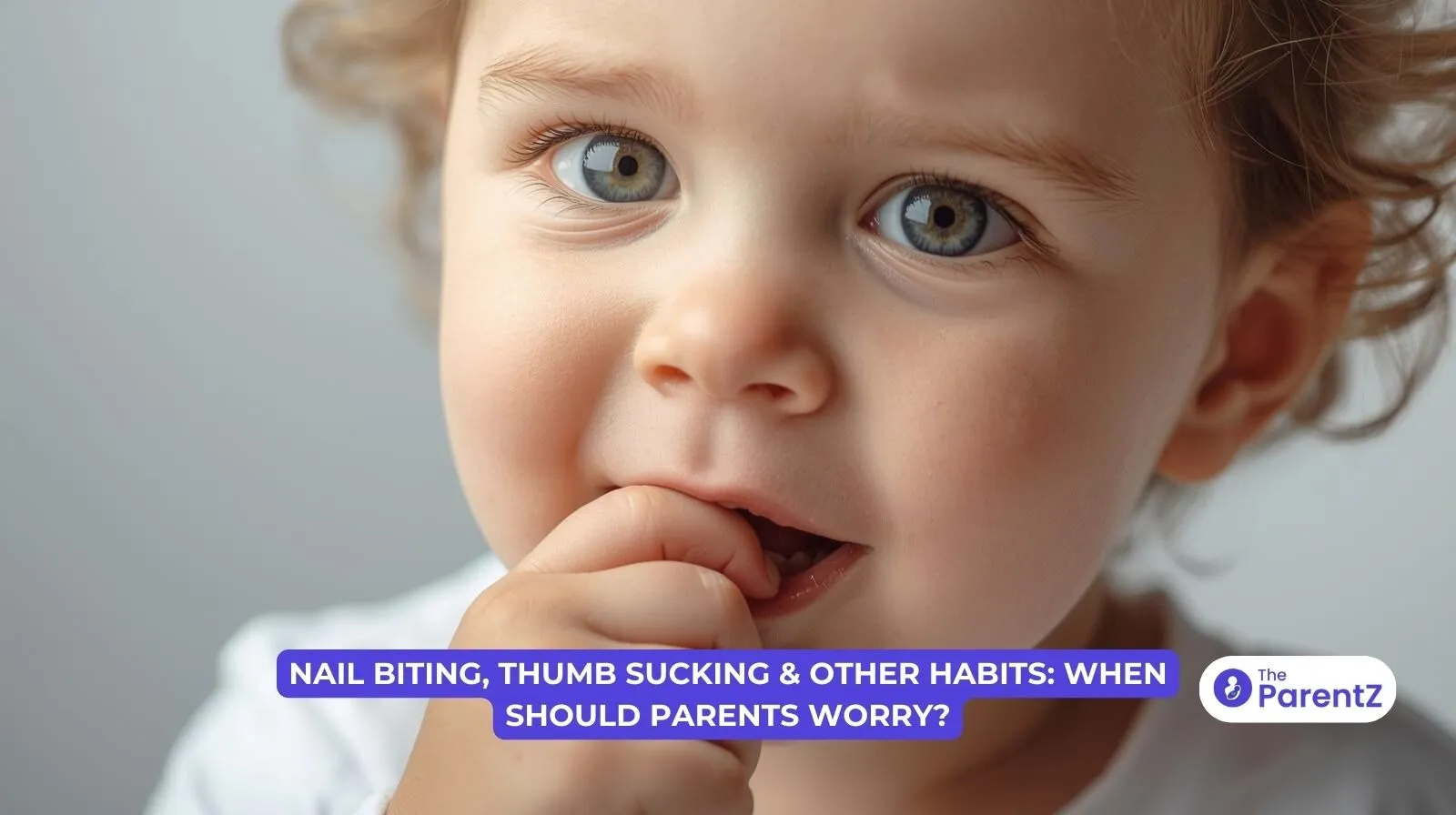
You're sitting at the dinner table, and you notice your 4-year-old has been chewing on their nails, again. Or maybe your kid still finds comfort in that thumb at bedtime, even though you thought they'd grown out of it.
These moments are incredibly common, and yet they can send even the calmest parent into a spiral of worry. Are these habits a sign of anxiety? Will they damage the teeth? Should something be done right now?
Before labelling anything as "bad," it helps to understand why children do these things. According to research, habits like thumb sucking, nail biting, hair twirling, and nose picking are essentially self-soothing behaviors. Kids repeat them because they work, they reduce tension, fill boredom, or simply help the child feel calm when the world around them feels like a lot.
Most of the time, children aren't even aware they're doing it. It's automatic. The same way adults tap their feet or scroll phones without thinking. Most of these habits appear in early childhood and often decrease as children grow older, though some may continue into later childhood.
So if your first instinct is panic, take a breath. You're probably looking at a completely normal phase.
Thumb sucking is one of the most instinctive behaviors in young children. Babies begin sucking reflexes even before birth, as prenatal scans often show babies with their thumbs in their mouths. It offers comfort, helps them fall asleep, and is entirely age-appropriate in the early years.
The age to watch: According to research, thumb sucking usually isn't a concern until a child's permanent teeth begin to come in, roughly around age 5 to 6. Before that, even if the habit continues, it's generally harmless. The American Academy of Pediatric Dentistry recommends parents begin gently encouraging children to stop after age 3, so the teeth have a chance to self-correct before permanent ones emerge.
Persistent thumb sucking after age 5 can, over time, affect how teeth align, push the upper front teeth forward, and in some cases alter the shape of the palate. Children who suck with a lot of force and frequency are at greater risk than those who simply rest the thumb passively in the mouth.
The social side matters too. By school age, kids themselves often become aware of the habit, and it can sometimes lead to teasing from peers.
When to act: If your child is still regularly sucking their thumb past age 5, it's worth having a conversation with their dentist. But scolding, pulling the thumb out forcibly, or constant reminders will almost always backfire, as it increases anxiety, which is often what drives the habit in the first place.
Studies suggest nail biting affects up to half of school-age children and teenagers. It's one of the most common childhood habits, and for most kids, the only real consequence is shorter nails.
That said, it's worth keeping an eye on. Research notes that if a child is biting to the point of bleeding, developing skin infections around the nail, or frequently getting sore, swollen fingertips, that's when a pediatrician should know.
Nail biting is usually tied to one of three things: boredom, stress, or just habit, something the child is doing on autopilot without realizing it. In some children, it spikes during transitions like starting a new school, a change at home, exam pressure, or even just a long car ride.
These also fall into the "very normal" category. The AAP lists hair twirling, cuticle picking, and nose picking as common habits that typically appear between ages 3 and 6.
Hair twirling is especially common in girls and often shows up as a way to self-soothe when tired or anxious. Most children grow out of it. However, if it progresses to hair pulling, especially if it results in noticeable hair loss, that's worth discussing with a pediatrician, as it could be a sign of a condition called trichotillomania, which is linked to anxiety or OCD in older children and teens.
Nose picking, while socially frowned upon, is usually harmless. Problems arise only if it's causing nosebleeds, or the child is picking to the point of injury.
Most childhood habits are nothing to lose sleep over. But here's when it's genuinely worth reaching out to a pediatrician or child psychologist:
1. Don't make it a big deal in the moment: The more you react, the more attention the habit gets, and sometimes, negative attention is still attention. The AAP's first recommendation for self-comforting habits is simply to ignore them.
2. Watch for triggers, not just the habit: Keep a mental note of when it happens. Is it in front of the TV? At bedtime? During homework? Understanding the trigger gives you something practical to work with.
3. Create a calm daily routine: Structured time after school, like a fixed snack time, outdoor play, homework, then wind-down, genuinely helps. Children with predictable routines tend to feel more secure, and that often reduces the frequency of these habits without any direct intervention.
4. Involve your child, don't lecture them: For children old enough to understand (generally 4–5 and above), a gentle, non-shaming conversation works far better than repeated corrections. Help them notice the habit without making them feel ashamed about it.
5. Offer their hands something else to do: Stress balls, clay, fidget toys, drawing, or anything that keeps the hands busy during moments when the habit usually kicks in. This is especially useful for nail biters who tend to act out of boredom.
6. Reward progress, not perfection: A simple sticker chart works surprisingly well with young children. Celebrate the days they manage well, without drawing attention to the days they don't.
Most of these habits are not a sign that something is wrong with your child or your parenting. They're a sign that your child is human, handling big feelings in the only ways they currently know how.
The goal isn't to eliminate the habit overnight. It's to gently, patiently guide your child toward other ways of self-soothing as they grow and their emotional toolkit expands. If something feels off, if your gut says this is more than just a phase, then trust that instinct and speak to your child's doctor. That's always the right call.
But for everything else? Offer warmth, stay consistent, and give it time. Most of these habits take care of themselves.
TheParentZ offers expert parenting tips & advice, along with tools for for tracking baby and child growth and development. Know more about Baby Growth and Development Tracker App.It serves as an online community for parents, providing valuable information on baby names, health, nutrition, activities, product reviews, childcare, child development and more
Disclaimer:
The views, thoughts, and opinions expressed in this article/blog are solely those of the author and do not necessarily reflect the views of The ParentZ. Any omissions, errors, or inaccuracies are the responsibility of the author. The ParentZ assumes no liability or responsibility for any content presented. Always consult a qualified professional for specific advice related to parenting, health, or child development.
Conversations (Comments) are opinions of our readers and are subject to our Community Guidelines.


Be the first one to comment on this story.