
Most Moms Report Slower Recovery After a Second Birth
Jul 19, 2026By Dr. Akanksha Priya
Most of us are doing the best we can, and our kids are growing up in a world we never imagined. YouTube shorts, Instagram reels, fast-cut cartoons, and more. Screens are everywhere, and sometimes a tablet babysitting your kid for 20 minutes is the only way dinner gets made.
No judgment here. But today we are going to talk about something that doesn't require a new app, a subscription, or a perfectly curated routine. It's called audio storytelling, and it might just be one of the quietest, most powerful tools sitting right under our noses.
When a child watches a fast-paced cartoon, their brain is basically in reaction mode, like processing visuals as fast as they come, one after another. There isn't much left for the brain to "do" on its own.
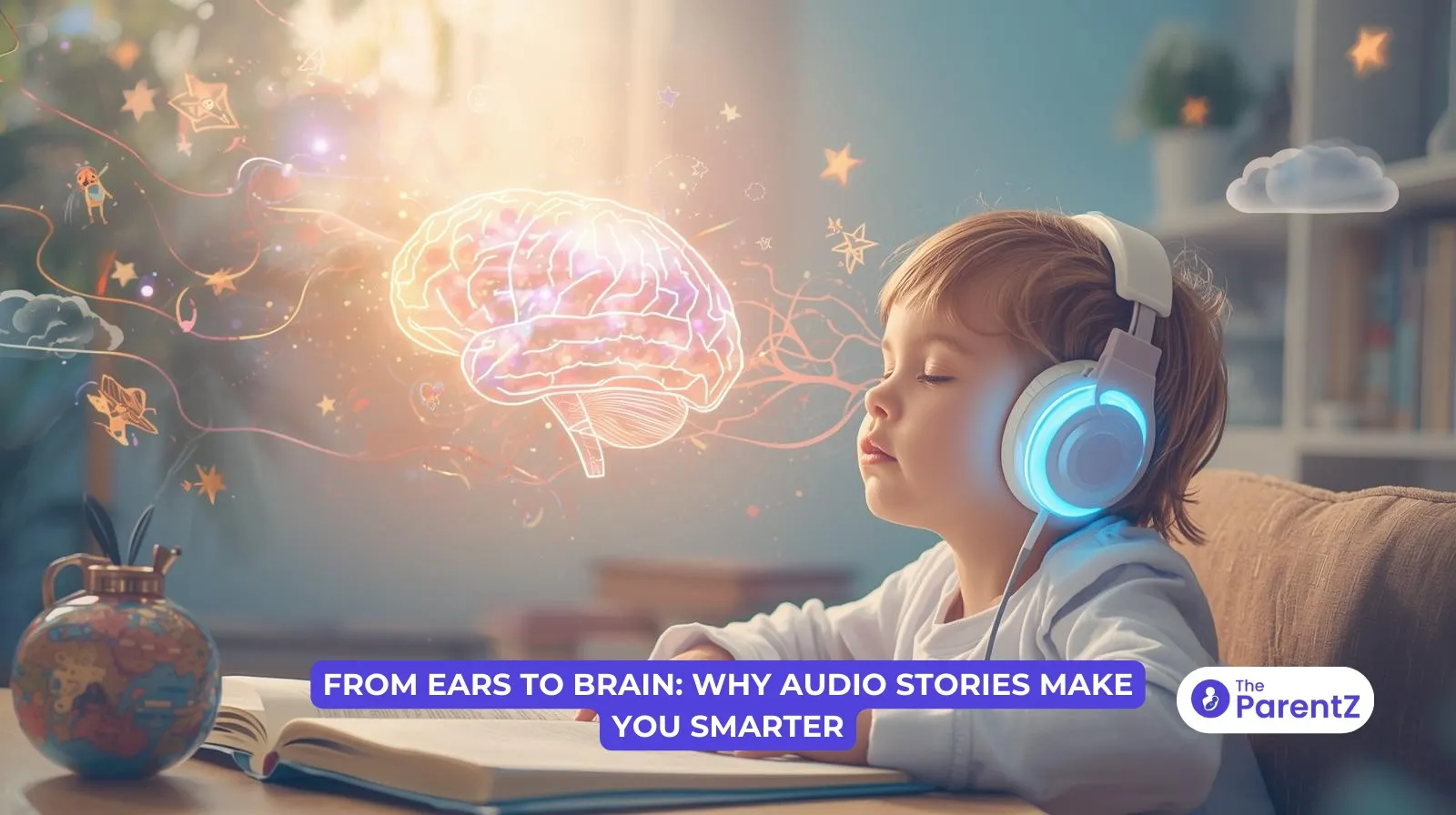
But when a child listens to a story, just a voice, maybe some music, no visuals, their brain has to fill in the blanks. It has to imagine what the forest looks like, what the grandmother sounds like, and what colour the dragon might be.
Research shows that storytelling provides significant psychological and educational benefits for children, including enhanced imagination to help visualize spoken words, improved vocabulary, and more refined communication skills. Essentially, the brain is doing its own creative heavy lifting, and that exercise is what builds it.
Children with greater story-listening exposure show higher activation in areas of the brain that facilitate mental imagery and extraction of meaning, the very same regions that are later connected to reading ability. In simple terms, listening to stories now is quietly preparing your child's brain to read and comprehend better later.
It's not just how much screen time kids get; it's what kind.
During animated stories, brain connectivity between language and imagery networks is actually lower, while the visual-perception network gets overstimulated, essentially working at the expense of deeper network integration. So even educational cartoons, while not without value, don't give the brain the same workout that pure listening does.
Audio stories work differently. Without visuals to lean on, the child's imagination, language processing, and emotional understanding all have to work together. That's not a limitation. That's the whole point.
This one is close to the heart of every Indian parent who worries about their child being kind, emotionally aware, and socially capable, and not just academically sharp.
Research found that audiobook usage was a statistically significant positive predictor of children's theory-of-mind performance, which is the ability to understand that other people have different thoughts, feelings, and perspectives. This is what empathy is built on. When children listen to characters handle loss, friendship, fear, or joy, they're quietly practising emotional intelligence.
We come from a culture where oral storytelling is not new. Dadi ke qisse, Panchatantra tales, and regional folklore, we already have this in our bones. Audio stories are basically a modern extension of that tradition.
Many of us grew up listening to stories on All India Radio, cassette tapes of Chandamama stories, or grandparents narrating Ramayana episodes at bedtime. That wasn't "old-fashioned." That was neuroscience working beautifully before anyone gave it a name.
Audio stories are not magic. They work slowly, the way all good things do. You won't see your child suddenly become a reading champion in a week. But what you will notice, over months, is a child who asks more questions, uses richer words, and handles big feelings a little more gracefully.
That's not a coincidence. That's a brain that's been quietly growing, one story at a time.
TheParentZ offers expert parenting tips & advice, along with tools for for tracking baby and child growth and development. Know more about Baby Growth and Development Tracker App.It serves as an online community for parents, providing valuable information on baby names, health, nutrition, activities, product reviews, childcare, child development and more
Disclaimer:
The views, thoughts, and opinions expressed in this article/blog are solely those of the author and do not necessarily reflect the views of The ParentZ. Any omissions, errors, or inaccuracies are the responsibility of the author. The ParentZ assumes no liability or responsibility for any content presented. Always consult a qualified professional for specific advice related to parenting, health, or child development.
Conversations (Comments) are opinions of our readers and are subject to our Community Guidelines.

Be the first one to comment on this story.