
Most Moms Report Slower Recovery After a Second Birth
Jul 19, 2026By Dr. Akanksha Priya
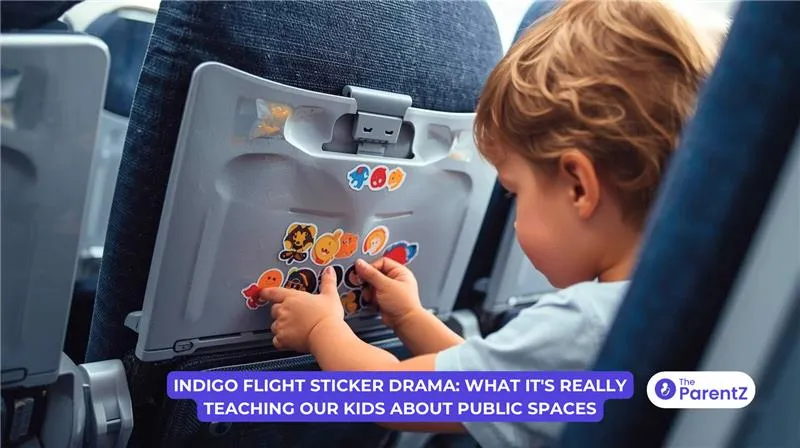
You're seated on an IndiGo flight, scrolling through your phone, half-asleep. The family next to you has a small child, maybe four, maybe five, who is very cheerfully pressing emoji stickers onto the seat tray in front of them. Peel. Stick. Peel. Stick. The parent is looking away. Nobody says anything.
Now ask yourself honestly, what's your first reaction?
If you're a parent, you probably felt a flicker of "okay, that's kind of cute." If you've ever travelled in India, on trains, in autos, through airports, you might have felt something else entirely. A quiet, tired kind of frustration. Because you've seen where this road goes.
That exact moment ended up on Reddit. And the comments that followed showed something much more interesting than an argument about stickers.
The Reddit post called it harmless fun. The internet disagreed. Loudly.
A chunk of people were genuinely bothered, and not in a "how dare you" way, but in a "we've all seen this play out before" way. The concern wasn't the stickers themselves. It was the silence around them. Nobody is stopping it. Nobody is explaining anything. Just a child learning, without words, that shared spaces don't need to be respected.
Others pushed back on that reaction. "It's a child. Relax." Some pointed out that getting worked up over stickers felt like misplaced energy. And honestly, that's fair too. Children do things. That's the job description of being a child.
But the loudest comments, on both sides, had very little to do with the child. They had everything to do with us. As a society. As parents. As people who travel together, live together, and share everything from airport queues to park benches to election booths.
The child was just the mirror.
Indians abroad often notice the contrast themselves. Queues that are actually respected. Streets that aren't treated as dustbins. Public toilets that don't require a hazmat suit. It's not that India lacks smart or capable people. It's that civic behavior, the habit of treating shared spaces well, that was never really drilled in. Not at home, not in schools, not out loud.
The "chalta hai" culture is real. It lives in the person who drops a chai cup on the platform and walks away. In the family that finishes a picnic and leaves everything behind. In the auto driver who reverses on a one-way because it's convenient. These aren't bad people. They just never had anyone consistently teach them otherwise.
Unfortunately, that cycle continues through us. Through what we say. Through what we ignore. Through what we laugh off as "kids being kids."
Children are not listening to your lectures about civic responsibility. They are watching your hands.
Do you drop the bill at the restaurant table and walk away, or do you put it in the little folder? Do you park on the footpath because it's "just for five minutes"? Do you throw the mango peel out of the moving car window? Do you cut the boarding queue because you spotted a gap?
Your child sees all of it. And they don't file it under "what Papa does." They file it under "what people do." That becomes their normal.
This is not guilt-tripping. This is just how children are wired. They absorb context before they absorb instruction. So the question for us as parents isn't "did I tell my child to behave?" It's "What are they seeing me do every single day?"
Nobody has time for complicated parenting frameworks. Here's what actually fits into a real Indian parent's day.
The child with the emoji stickers was not a future vandal. They were just children doing what children do: exploring, playing, and testing the world around them.
The real question was never about the stickers. It was about what happens next. Does someone step in? Does someone explain? Does the parent treat it as a teaching moment or a non-event?
We live in a country where civic sense is genuinely improving, slowly, in patches, but it is moving. Every generation of parents has a chance to push that a little further. Not through grand gestures. Just through the ordinary, repeated, quiet act of showing their children how to exist thoughtfully in a shared world.
TheParentZ offers expert parenting tips & advice, along with tools for for tracking baby and child growth and development. Know more about Baby Growth and Development Tracker App.It serves as an online community for parents, providing valuable information on baby names, health, nutrition, activities, product reviews, childcare, child development and more
Disclaimer:
The views, thoughts, and opinions expressed in this article/blog are solely those of the author and do not necessarily reflect the views of The ParentZ. Any omissions, errors, or inaccuracies are the responsibility of the author. The ParentZ assumes no liability or responsibility for any content presented. Always consult a qualified professional for specific advice related to parenting, health, or child development.
Conversations (Comments) are opinions of our readers and are subject to our Community Guidelines.

Be the first one to comment on this story.