
Most Moms Report Slower Recovery After a Second Birth
Jul 19, 2026By Dr. Akanksha Priya
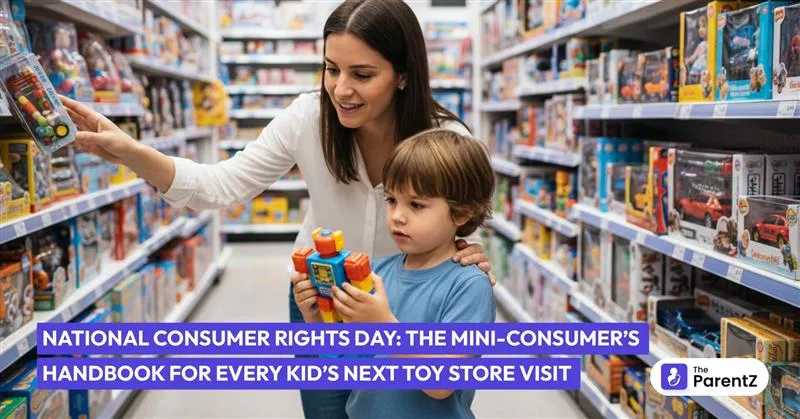
You're at the toy store, and your seven-year-old is clutching a brightly colored action figure. The packaging screams "Super Fun!" but when you flip it over, the manufacturing date is suspiciously faded, and there's no proper safety certification mark. Your child is tugging at your sleeve, but something doesn't feel right.
This is exactly where consumer rights education begins, not with boring lectures, but with real moments that matter.
With National Consumer Rights Day observed in India on December 24, there's no better time to turn your next toy shopping trip into a fun learning adventure. And the best part? You don't need to memorize the entire Consumer Protection Act, 2019. You just need a simple handbook that your kids can actually use.
So, let’s turn some consumer rights recognised under Indian consumer law into questions kids can ask while toy shopping.
Every toy should have proper safety certifications, age-appropriate warnings, and no sharp edges or small parts that could be dangerous.
Turn it into a game called "Safety Detective." Before putting any toy in the cart, your child gets to be the detective who checks:
Pro Tip: Start with obvious examples. "See this toy? It says 3+ years. Your little brother is only 2, so this could be dangerous for him because of these small pieces. Can you spot what makes it unsafe?"Kids love finding things adults miss. Use that natural curiosity.
Kids deserve to know what they're buying, like what it does, what it's made of, who made it, and the manufacturing details.
Create a simple "Toy Info Card" game. Before choosing a toy, your child needs to find three things:
Pro Tip: Many toys in India come with packaging that makes tall claims, like "Increases IQ!" or "Makes kids genius!" Teach your child to ask, "But what does it actually DO?" If a toy package says it's educational, ask them to explain how. If they can't, maybe it's just clever marketing.
This isn't about being cynical; it's about thinking critically.
They don't have to buy the first toy they see, even if it's heavily advertised or their friend has it.
Before any toy store visit, introduce the "Rule of Three": Look at three similar toys before deciding. This simple rule slows down impulse buying and teaches comparison.
Pro Tip: When your child wants a particular toy, say: "Great choice! Now let's find two more similar toys and compare them." Look at prices, features, and reviews together. Often, you'll find a better option that your child actually prefers once they've seen alternatives.
This works because it doesn't say "no," it says "let's explore."
It's okay to ask the shopkeeper questions. In fact, it's smart!
Practice three simple questions before entering the store:
Pro Tip: This is where many parents stumble because we don't want to seem difficult or annoying. Frame it as teaching your child to be polite AND assertive. "Asking questions doesn't mean you're being rude. It means you're being smart."
Let your child ask one question to the shopkeeper (with your support). Start small, maybe just asking where a toy is made. Build up their confidence over multiple visits.
If a toy is defective or doesn't work as promised, there are ways to fix the problem.
Create a "Receipt Treasure Box" at home. Every time you buy a toy, let your child put the receipt in the box. Explain it like this: "This little piece of paper is like a superhero cape for consumers. If something goes wrong, this helps us fix it."
Pro Tip: When something actually goes wrong with a toy (and it will), involve your child in the complaint process. Show them the receipt, call the customer helpline together, or visit the store for an exchange. They'll remember this lesson for life.
Being a smart consumer is a lifelong skill, not a one-time lesson.
After each toy purchase, have a quick five-minute "Consumer Talk" at home. Ask:
Pro Tip: Don't turn this into a test. Make it casual, maybe during snack time or the car ride home. The goal is repetition without pressure.
Consumer education doesn't have to be complicated. It doesn't require perfect knowledge of every law or right. It just requires consistent, practical application of simple principles. The next time you're in a toy store and your child is excited about a purchase, you'll have tools that actually work.
This December 24, celebrate National Consumer Rights Day by creating your own Mini-Consumer’s Handbook.
TheParentZ offers expert parenting tips & advice, along with tools for for tracking baby and child growth and development. Know more about Baby Growth and Development Tracker App.It serves as an online community for parents, providing valuable information on baby names, health, nutrition, activities, product reviews, childcare, child development and more
Disclaimer:
The views, thoughts, and opinions expressed in this article/blog are solely those of the author and do not necessarily reflect the views of The ParentZ. Any omissions, errors, or inaccuracies are the responsibility of the author. The ParentZ assumes no liability or responsibility for any content presented. Always consult a qualified professional for specific advice related to parenting, health, or child development.
Conversations (Comments) are opinions of our readers and are subject to our Community Guidelines.



Be the first one to comment on this story.