
Most Moms Report Slower Recovery After a Second Birth
Jul 19, 2026By Dr. Akanksha Priya
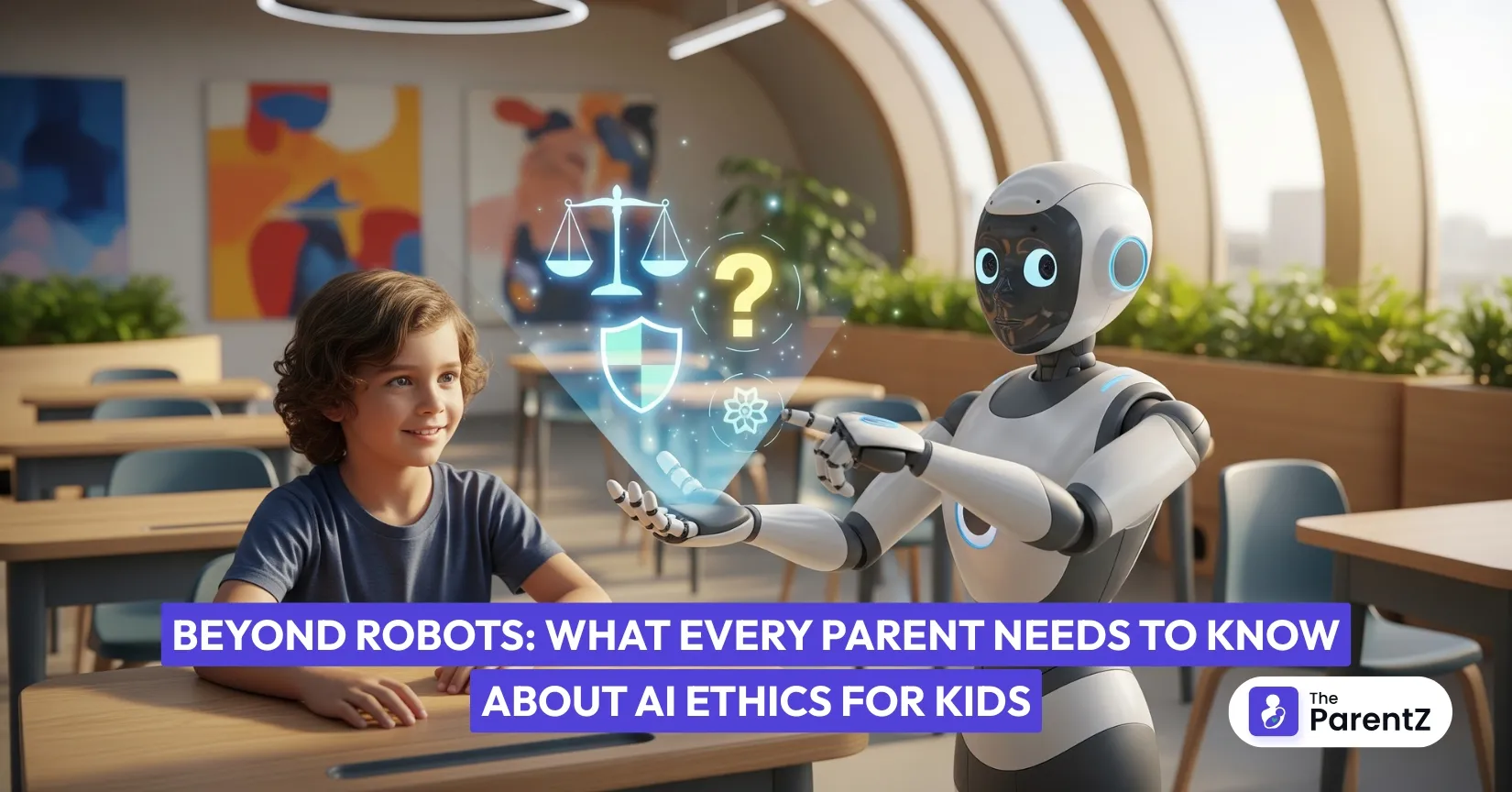
When we think about AI and kids, most of us picture cute robots or helpful homework assistants. But here's what's actually happening right now: your kid's probably already using AI whether you know it or not. And with the government planning to introduce AI as a mandatory subject from Class 3 starting in the 2026-27 academic year, this isn't some future problem anymore.
It's happening now. In our homes. In our schools.
AI isn't just helping kids with math problems. It's making decisions that affect their lives in ways we're only beginning to understand. And unlike that iPad game phase they went through, this technology isn't going anywhere. A Northeastern University professor, Hossein Dabbagh, even argues that teaching kids about AI ethics should be as fundamental as sex or drug education.
When OpenAI introduced parental controls for ChatGPT in October 2025, a tech-savvy parent circumvented them in about five minutes by simply logging out and creating a new account. If you think you've got this locked down with parental controls alone, think again. Our kids are smart. They'll find workarounds.
But it gets more serious. U.S. senators introduced bipartisan legislation in October 2025 to crack down on AI chatbot companions for minors, following complaints from parents who blamed these products for pushing their children into sexual conversations and even suicide. This isn't theoretical anymore.
A Stanford University study found that AI systems falsely flag essays written by non-native English speakers as AI-generated, potentially leading to false accusations of cheating.
Think about that for a second. A kid from a Hindi-medium school who's writing in English, their second or third language, could get accused of cheating because the AI doesn't recognize their writing pattern. That's not a bug. That's bias baked into the system.
And it doesn't stop there. MIT scientists discovered that language models think "flight attendant" and "secretary" are feminine jobs, while "fisherman," "lawyer," and "judge" are masculine. Facial recognition technology may not accurately recognize Black students. Despite the increasing adoption of AI technologies, significant disparities in access, infrastructure, and teacher training hinder equitable educational delivery, with concerns about data privacy and algorithmic bias.
These aren't abstract problems. They're actively shaping how AI responds to your kids right now.
The Government of India's National Education Policy (NEP) 2020 emphasizes the integration of AI curriculum at all educational levels and aims to equip students with skills like digital literacy, coding, and computational thinking. UNESCO also recommends that Member States provide adequate AI literacy education to the public on all levels.
But what does that actually mean for your family?
Your kid doesn't need to be the next Sundar Pichai to navigate this AI world. But they do need to understand that AI is a tool created by humans, trained on human data, and full of human bias. It's powerful, it's everywhere, and it's not going away.
TheParentZ offers expert parenting tips & advice, along with tools for for tracking baby and child growth and development. Know more about Baby Growth and Development Tracker App.It serves as an online community for parents, providing valuable information on baby names, health, nutrition, activities, product reviews, childcare, child development and more
Disclaimer:
The views, thoughts, and opinions expressed in this article/blog are solely those of the author and do not necessarily reflect the views of The ParentZ. Any omissions, errors, or inaccuracies are the responsibility of the author. The ParentZ assumes no liability or responsibility for any content presented. Always consult a qualified professional for specific advice related to parenting, health, or child development.
Conversations (Comments) are opinions of our readers and are subject to our Community Guidelines.



Be the first one to comment on this story.