
Most Moms Report Slower Recovery After a Second Birth
Jul 19, 2026By Dr. Akanksha Priya
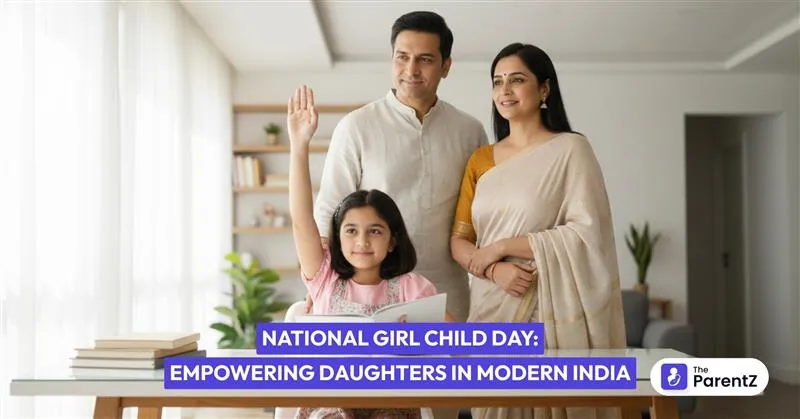
Every year on January 24, India observes National Girl Child Day. Most of us know about the day, but do we really understand what it stands for? More importantly, are we raising our daughters (and sons) to truly believe that girls are equal, valuable, and capable of anything?
The Ministry of Women and Child Development started National Girl Child Day in 2008. Why? Because despite all our progress, girls in India were (and still are, in many places) facing discrimination, right from birth.
This day isn't just about celebration. It's a wake-up call. It reminds us to address uncomfortable truths: female foeticide, child marriage, educational inequality, and the deeply rooted belief that sons are somehow more valuable than daughters.
According to recent data from the National Family Health Survey (NFHS-5), India's sex ratio at birth stands at 929 females per 1,000 males, which is an improvement over previous years but still lower than the natural ratio of 952. In states like Haryana, the situation dropped to 910 girls per 1,000 boys in 2024, the lowest since 2016. These aren't just numbers. They represent missing daughters.
Think about the world your daughter is growing up in. Yes, we've come far. Women are CEOs, pilots, astronauts, and prime ministers. But zoom into everyday life, and you'll still see the invisible expectations:
These aren't just old-fashioned ideas from grandparents. These beliefs are passed down every single day through our actions, our silences, and our "harmless" comments.
In 2025, nearly 30 lakh adolescent girls dropped out of school in India over five years. That's almost half of all dropouts. Why? Poverty, household work, early marriage, and the belief that educating a girl is less important than educating a boy.
Forget the theories. Here's what you can actually do:
Don't just say education matters; prove it. If you're spending ₹50,000 on your son's coaching classes, spend the same on your daughter's. If your son gets a laptop for his studies, so should your daughter. No compromises, no excuses.
Starting today, involve your son in the kitchen. Involve your daughter in changing light bulbs. Make them both do dishes. Both fold clothes. Both clean their rooms.
If your daughter sees her brother lounging while she's expected to serve him tea, what message does that send?
What clothes she wants to wear (within reason). What hobby she wants to pursue. What career she dreams of. Whether she wants short hair or long. Whether she prefers cricket to dance.
Stop framing everything through the lens of "what will people say?" Start asking, "What does she want?"
Open a savings account in her name. Teach her about money, investments, and budgets. Don't wait until she's married or earning. Start now. Financial independence is freedom.
The Sukanya Samriddhi Yojana is specifically designed for girl children—use it. Explain to your daughter what it means, why it exists, and how it will benefit her future.
Don't whisper about menstruation. Don't make it shameful or secretive. Educate both your sons and daughters about periods. Normalize it.
Ensure your daughter has access to sanitary products, pain relief if needed, and nutritious food. Anaemia is a real problem for adolescent girls, so get regular health check-ups.
When you see an ad that shows only mothers cleaning or only fathers working, point it out. When someone makes a "girls can't do math" joke, call it out. When relatives say, "At least you have one son," shut it down.
Your silence is agreement. Your words teach them what's acceptable.
Did she score well? Celebrate. Did she stand up to a bully? Celebrate. Did she learn to ride a bike? Celebrate. Did she help a friend? Celebrate.
Not with comparisons to boys. Not with "you're so good for a girl." Just celebrate her.
Let her know she can talk to you about anything, like friendships, body image, peer pressure, online harassment, consent, safety. Don't freak out. Don't lecture. Just listen first, then guide.
The world can be harsh on girls. Your home should be her safe space.
Kids learn from what they see, not what you preach. If your daughter sees her father helping with housework, making decisions together with her mother, and treating her mother as an equal partner, she'll expect the same in her future relationships.
If she sees her mother giving up her career, her dreams, her voice, that becomes her template for womanhood.
Yes, the world isn't always safe. But instead of just saying "don't go out alone" or "be careful," teach her self-defense. Teach her to trust her instincts. Teach her it's okay to be rude to people who make her uncomfortable. Teach her to say no loudly.
Teach your son that consent matters. That NO means NO. That girls aren't objects.
Before we lecture society, let's look inward:
These questions aren't meant to shame you. They're meant to make you think. Because change starts at home. With us. With you.
National Girl Child Day isn't about posting on social media with hashtags and forgetting about it the next day. It's not about one-day celebrations at school with speeches and prizes.
It's about every single day after that.
It's about raising sons who respect women and daughters who know their worth. It's about breaking generational patterns of discrimination. It's about looking at your daughter and seeing infinite possibilities; not a burden, not a responsibility, not a checklist item before marriage.
It's about seeing her as fully human. Fully capable. Fully deserving of every opportunity her brother gets.
Your daughter is not your honor that needs protection. She's not your property that needs to be handed over to another family. She's not less valuable because she can't carry forward your surname.
She is your child. She is the future. She deserves everything.
This January 24, don't just mark National Girl Child Day on your calendar. Make a promise:
Because empowering daughters isn't just good parenting; it's how we build a better India.
And that starts with you.
TheParentZ offers expert parenting tips & advice, along with tools for for tracking baby and child growth and development. Know more about Baby Growth and Development Tracker App.It serves as an online community for parents, providing valuable information on baby names, health, nutrition, activities, product reviews, childcare, child development and more
Disclaimer:
The views, thoughts, and opinions expressed in this article/blog are solely those of the author and do not necessarily reflect the views of The ParentZ. Any omissions, errors, or inaccuracies are the responsibility of the author. The ParentZ assumes no liability or responsibility for any content presented. Always consult a qualified professional for specific advice related to parenting, health, or child development.
Conversations (Comments) are opinions of our readers and are subject to our Community Guidelines.


Be the first one to comment on this story.