
Most Moms Report Slower Recovery After a Second Birth
Jul 19, 2026By Dr. Akanksha Priya
Your child is struggling with their shoelaces, getting frustrated with homework, or can't quite reach that toy on the shelf. Your instinct kicks in immediately, "Let me help you." It feels natural, loving even. After all, isn't that what good parents do?
Unfortunately, we might be loving our kids right out of their ability to solve problems on their own.
In Indian households, helping our children is deeply ingrained in our parenting DNA. We pack their school bags well into middle school. We organize their study tables. We intervene the moment we see them struggle. It comes from a beautiful place; we want to protect them, ease their burden, show them we care.
But between tuition classes, competitive exams, and the pressure to excel, our kids are growing up in an environment where someone is always solving problems for them. And then we wonder why our teenager can't figure out how to book a train ticket or why our twelve-year-old panics when they forget their lunch box.
The truth is that we've accidentally taught them that struggle means failure, and that someone will always be there to rescue them.
When we constantly say "let me help" before our child has truly tried, we send an unintended message: I don't think you can do this on your own.
Think about it from their perspective. Every time we swoop in to tie those laces, complete that puzzle, or fix that science project, we're telling them their effort wasn't good enough. We're teaching them that frustration is something to avoid rather than work through.
Research in child development consistently shows that children who are given space to struggle (with appropriate support nearby) develop better:
In the future, our kids will face challenges we can't even imagine yet, from AI-driven workplaces to complex global issues; so the ability to handle difficulty isn't just nice to have. It's essential.
"Try again" is powerful because it acknowledges three critical things:
When a child hears "try again," they learn that their parent sees them as capable. That their struggle has purpose. That it's okay to not get it right the first time, or even the fifth time.
We are not talking about abandoning your child or watching them melt down when you're already late. This is about strategic patience.
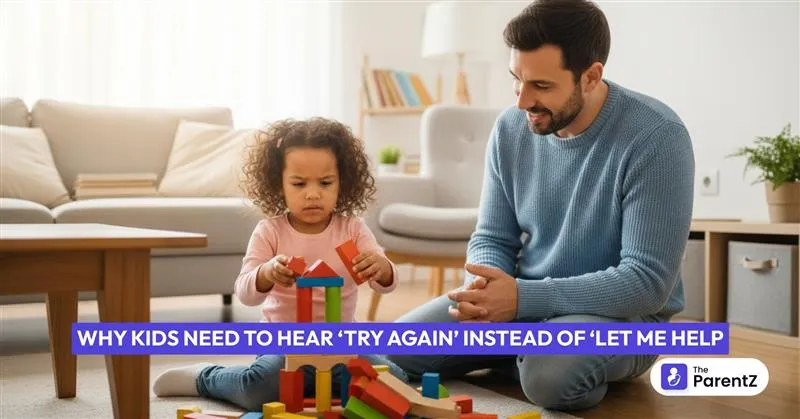
Begin where failure doesn't really matter. Can't open the water bottle? Give them an extra 30 seconds before helping. Struggling to find their favorite book? Let them search a bit longer. Building with blocks that keep falling? Resist fixing it immediately. These moments build persistence.
Before you jump in, ask, "Would you like me to show you, or do you want to try once more?" This simple question gives them agency. Sometimes they'll ask for help, and that's perfectly fine. They're learning to assess their own needs.
Instead of doing it for them, try asking, "What's the first step? Okay, try that. What comes next?" You're coaching from the sidelines, not rescuing. There's a massive difference.
"I saw you trying three different ways to solve that problem. That's smart thinking." This shifts focus from outcome to process. In a culture focused on marks and ranks, this reframing is revolutionary.
This is where parental judgment matters. If your child is genuinely stuck, frustrated to the point of shutdown, or facing something beyond them, step in. The goal is to let them stretch just beyond their comfort zone.
Pro Tip: If they're frustrated but engaged, hold back. If they've shut down or are distressed, it's time to support.
Watch for these signs that it's time to step in:
Remember, "try again" means being present while they work through challenges, ready to support but not to rescue.
You're not going to get this right every time. You'll still jump in when you're rushed. You'll still do things for them when you're tired. That's okay. But if you can shift from "let me help" to "try again" even 30% more often, you'll notice that your child will start believing in themselves in new ways.
And isn't that what we really want? Not just kids who can tie their shoes or solve math problems, but young people who face difficulty and think, "I can figure this out" instead of "I need someone to do this for me."
That confidence? That resilience? It's built, one "try again" at a time.
TheParentZ offers expert parenting tips & advice, along with tools for for tracking baby and child growth and development. Know more about Baby Growth and Development Tracker App.It serves as an online community for parents, providing valuable information on baby names, health, nutrition, activities, product reviews, childcare, child development and more
Disclaimer:
The views, thoughts, and opinions expressed in this article/blog are solely those of the author and do not necessarily reflect the views of The ParentZ. Any omissions, errors, or inaccuracies are the responsibility of the author. The ParentZ assumes no liability or responsibility for any content presented. Always consult a qualified professional for specific advice related to parenting, health, or child development.
Conversations (Comments) are opinions of our readers and are subject to our Community Guidelines.



Be the first one to comment on this story.