
Most Moms Report Slower Recovery After a Second Birth
Jul 19, 2026By Dr. Akanksha Priya
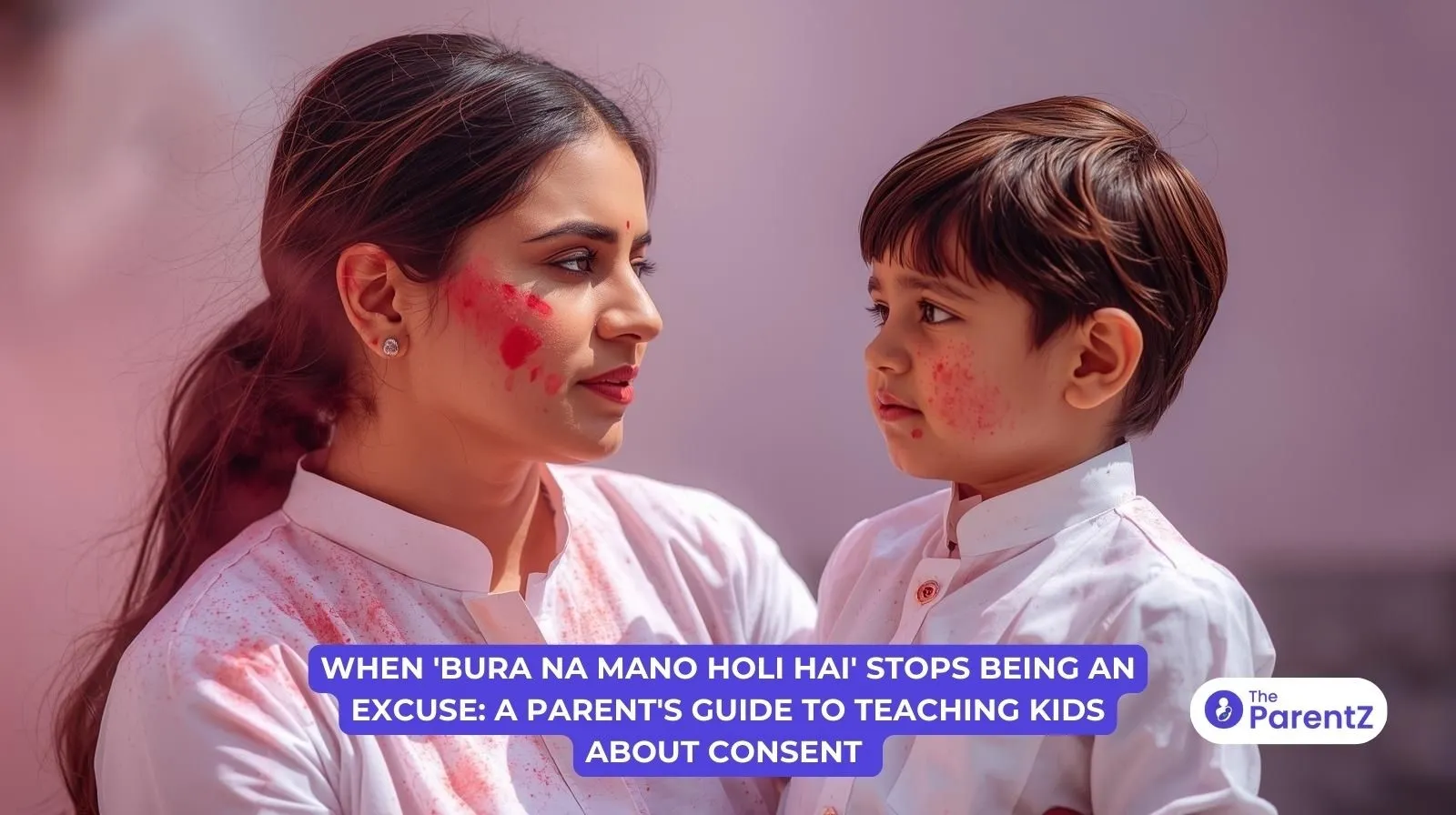
The drums are already playing in your child's head. Holi is coming, and you can feel it in the house. The excitement is real. The colour packets are already being stacked. Someone's already asked you three times, "Mummy, can we get the pichkari with the big tank?"
Holi is the one festival where they get full permission to be absolutely chaotic, to run outside, drench their friends, smear colour on everyone's face, and laugh until their stomach hurts. Schools build up to it. Housing societies organise events. Even the most reserved kid becomes a tiny tornado during Holi.
And that energy? That joy? That's beautiful. That's worth protecting.
But somewhere in all that madness, every single year, things go too far. A woman who said no gets drenched anyway. A person who stepped out "just for five minutes" gets surrounded and smeared by strangers. Someone's uncle or neighbour decides the festival gives them a free pass to touch people who are clearly uncomfortable. And when anyone objects, out comes the line: "Bura na mano, Holi hai!"
We've all seen the news. We've all seen the reels. Many adults, women especially, but men too, actively avoid going out on Holi for this exact reason. They love the festival. They've just been burned too many times by people who use it as cover for behaviour that would never be okay on any other day.
This didn't start with adults. It starts younger than we'd like to admit. Which is exactly why this conversation belongs with your kids, before the festival week hits.
Before any parent reading this starts feeling guilty for "overthinking," let's say it plainly: teaching your child about consent before Holi does not take away from the fun. It actually makes the fun better, because your child learns how to play without hurting someone else's celebration.
You don't need a big sit-down lecture. You don't need to print worksheets. You just need about ten minutes and a normal conversation.
Everything comes down to this: Holi is a game, and games need both players to agree.
You wouldn't force someone to play cricket if they didn't want to. You wouldn't grab someone's phone and take a photo if they said no. The same thing applies to colour and water.
Ask your child, "If your friend said they don't want colour on their face, what do you do?"
Most kids, when asked directly, will say the right thing. They're not bad kids. They just need to hear it said out loud, clearly, before the moment happens. Because in the middle of the chaos, kids do what feels normal, and what feels normal is what we've taught them ahead of time.
You don't need complicated rules. Give them simple phrases to use and recognise:
This part is uncomfortable, but important. Kids need to know that adults can also behave badly on Holi, and they're allowed to say no to adults too.
Tell your child: "If any uncle, aunty, or anyone older makes you feel uncomfortable, if they put colour on you when you didn't want it, or touched you and it didn't feel okay, you come and tell me. You will not be in trouble."
Many children stay quiet about uncomfortable situations because they're afraid they'll be scolded for "making a scene" or "being rude to elders." Remove that fear. Tell them clearly that coming to you is always the right thing to do.
Some kids genuinely don't like the mess of Holi. The noise, the crowds, the colour getting in their eyes; it's overwhelming for some children. That's okay.
Let your child know that choosing to play is different from being pushed to play. They can stand at the edge and watch. They can come inside if it gets to be too much. Their experience of the festival matters too.
And if your child is the one who loves Holi and wants to drench everyone? Teach them to read the room. The kid who's hiding behind their parent probably doesn't want colour on their face. The elderly neighbour who stepped out for milk wasn't signing up for a water fight. Excitement is great. Awareness makes it better.
It's a beautiful phrase in its original spirit. It means don't take offence, it's Holi, we're all celebrating together. That's a lovely idea.
But it has been twisted, year after year, into something that silences people who are genuinely uncomfortable. It gets used to override someone's "no." It gets used to make the person with the boundary feel like they're ruining everyone's fun.
Teach your child the difference. Bura na mano Holi hai is about not holding a grudge over playful colour during the festival. It was never meant to mean ignore what someone is telling you with their words and body.
One is the spirit of the festival. The other is just an excuse.
Holi is one of the most genuinely joyful festivals in the world. Color, music, water, sweets, family, and strangers becoming friends for a day. It is magical when it is mutual.
The goal of this conversation is not to make your child afraid of Holi or suspicious of everyone around them. The goal is to raise a child who adds to the joy, not one who takes it away from someone else.
That child will have a better Holi too. Because the best kind of fun is always the kind where everyone, genuinely, is having it.
Happy Holi. Play hard. Play kindly.
TheParentZ offers expert parenting tips & advice, along with tools for for tracking baby and child growth and development. Know more about Baby Growth and Development Tracker App.It serves as an online community for parents, providing valuable information on baby names, health, nutrition, activities, product reviews, childcare, child development and more
Disclaimer:
The views, thoughts, and opinions expressed in this article/blog are solely those of the author and do not necessarily reflect the views of The ParentZ. Any omissions, errors, or inaccuracies are the responsibility of the author. The ParentZ assumes no liability or responsibility for any content presented. Always consult a qualified professional for specific advice related to parenting, health, or child development.
Conversations (Comments) are opinions of our readers and are subject to our Community Guidelines.


Be the first one to comment on this story.