
Most Moms Report Slower Recovery After a Second Birth
Jul 19, 2026By Dr. Akanksha Priya
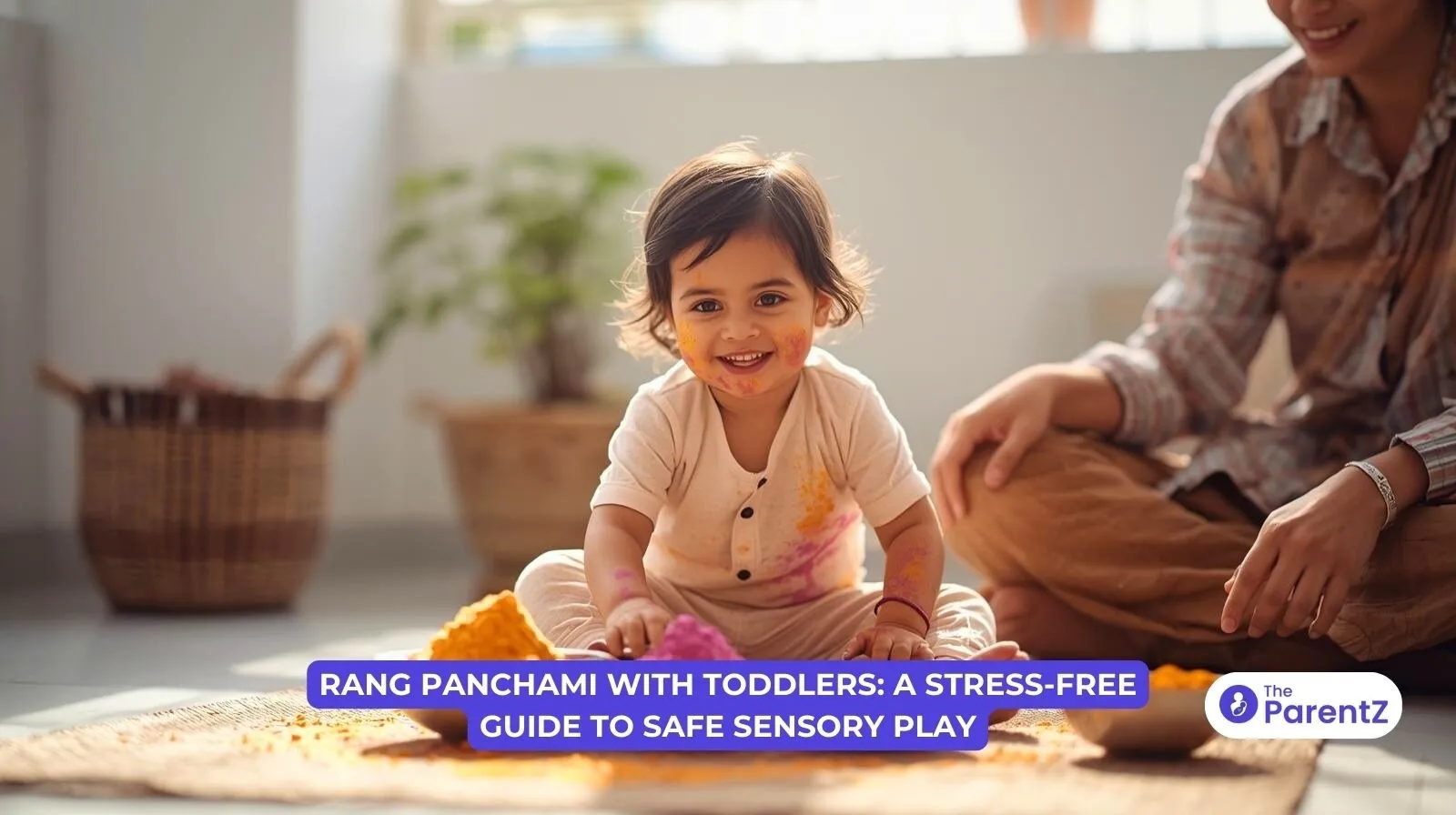
Holi just happened. You spent two days scrubbing pink out of your child's ears, picking gulal out of the dog's fur, and explaining to your mother-in-law why the white sofa cushion is now lavender. You finally exhaled.
And now someone in your building WhatsApp group has sent a "Happy Rang Panchami" message with a confetti GIF.
Deep breath. This one is actually simpler. And if you have a toddler at home, Rang Panchami might be your chance to properly enjoy the colors with them, without the crowd madness, the water guns, or the stranger uncle who thinks your 2-year-old wants a face full of chemical gulal.
Let's talk about how to actually do this well.
Yes, and it's worth knowing this.
Holi marks the burning of Holika and the triumph of good over evil. Rang Panchami, which comes five days after Holi on the Panchami tithi of Krishna Paksha in Phalguna month, is something else. It's considered the closing ceremony of the entire Holi season. And according to old belief, it's the day the gods themselves come down to play with colors. That's why it's also called Dev Panchami, as devi-devta descend, and the colors thrown into the air are not just for fun but are meant to carry positivity upward and clear out negativity. Very different energy from a water balloon fight.
In Maharashtra and Madhya Pradesh, it's celebrated quite enthusiastically, with processions, music, and gulal flying everywhere. In Indore especially, Rang Panchami is bigger than Holi itself. In the Braj region, including Mathura and Vrindavan, the temples celebrate with priests showering devotees with gulal as the final offering of the Holi season, connected to the love of Radha and Krishna. In Chhattisgarh, they call it Dhoola Panchami and celebrate it with their own folk customs.
So no, it's not just "Holi again." It's quieter, more local, a little more devotional.
Holi with a toddler is a lot. Loud, crowded, strangers everywhere, colors that sting the eyes, water that's freezing, and your child is just trying to process all of it while everyone around them is in full chaos mode.
Rang Panchami, by comparison, tends to be a neighborhood thing. Your building. Your colony. Your family. It's on a scale where you are actually in control.
And that matters when you have a toddler who can go from delighted to full meltdown in about 45 seconds.
You can set it up on your own terms, on your balcony, or in your building compound, with your rules. That's the sweet spot.
This is the part that makes most parents nervous, and fairly so.
A lot of the gulal and colors you find in the market, the ones in those shiny packets, are made with synthetic dyes, chemicals, and sometimes even industrial ingredients. For adults, it might cause a rash at worst. For a toddler with skin that's still sensitive, or one who will absolutely try to lick the color off their hand, it's not great.
That is why what you probably already have at home works just as well, if not better:
That's it. Four colors, all from things that are already in Indian homes. No special order, no expensive organic brand required.
If you do want to buy something, look for herbal or flower-based gulal. Several brands sell it now, and even a small packet is enough for a toddler-sized celebration at home.
You do not need a setup. Let’s see what works:
Spread an old bedsheet or some newspaper on the balcony floor or in the building compound. Put the colors in small katoris. That's your station.
Let your toddler touch the colors first, just with their fingers. Let them rub it on their own hands, feel the texture, and get used to it before anyone starts putting it on their face. If they hate the texture, great, now you know, and you can skip the color entirely and just do sweets and celebrate that way.
Dress them in old white clothes. White shows color beautifully and you're not worrying about staining anything you actually care about. Your toddler also gets the thrill of being allowed to make a mess on purpose, which is genuinely one of the great joys of toddlerhood.
Go near the face only if they're comfortable. A small tika of gulal is enough. No surprises, no throwing color at the face without warning. That's how the meltdown happens.
If there's a dadi, nana, or any grandparent nearby, get them involved. Even a video call where your toddler shows off their colorful palms to Nani in another city is one of those small moments that ends up being a big memory. This festival has always been about generations playing together.
And make one thing in the kitchen. It doesn't have to be elaborate. Gujiya from the sweet shop around the corner, warm jalebis, thandai without bhang for the kid, just something that smells like a celebration. Food is how kids file memories.
You don't have to give your toddler a lecture on the significance of Rang Panchami. They don't need a lecture.
But you can tell them, simply, in whatever language you speak at home, that “Today even the gods are playing with colors.”
That's it. That's the seed. The smell of turmeric on their hands. The sound of neighbors laughing downstairs. The taste of something sweet. The feeling of color on their skin for the first time, and your face telling them it's okay, it's fun, this is ours.
That's what they'll carry forward. Not the Wikipedia version. The kitchen-balcony-dadi-on-video-call version.
Want More of This Kind of Parenting Content?
Real tips, rooted in culture, that don't make your life harder or your wallet lighter? That's what TheParentz.com is all about.
Festivals, milestones, tantrums, and first foods. We've got parents like you covered.

TheParentZ offers expert parenting tips & advice, along with tools for for tracking baby and child growth and development. Know more about Baby Growth and Development Tracker App.It serves as an online community for parents, providing valuable information on baby names, health, nutrition, activities, product reviews, childcare, child development and more
Disclaimer:
The views, thoughts, and opinions expressed in this article/blog are solely those of the author and do not necessarily reflect the views of The ParentZ. Any omissions, errors, or inaccuracies are the responsibility of the author. The ParentZ assumes no liability or responsibility for any content presented. Always consult a qualified professional for specific advice related to parenting, health, or child development.
Conversations (Comments) are opinions of our readers and are subject to our Community Guidelines.


Be the first one to comment on this story.