
Most Moms Report Slower Recovery After a Second Birth
Jul 19, 2026By Dr. Akanksha Priya
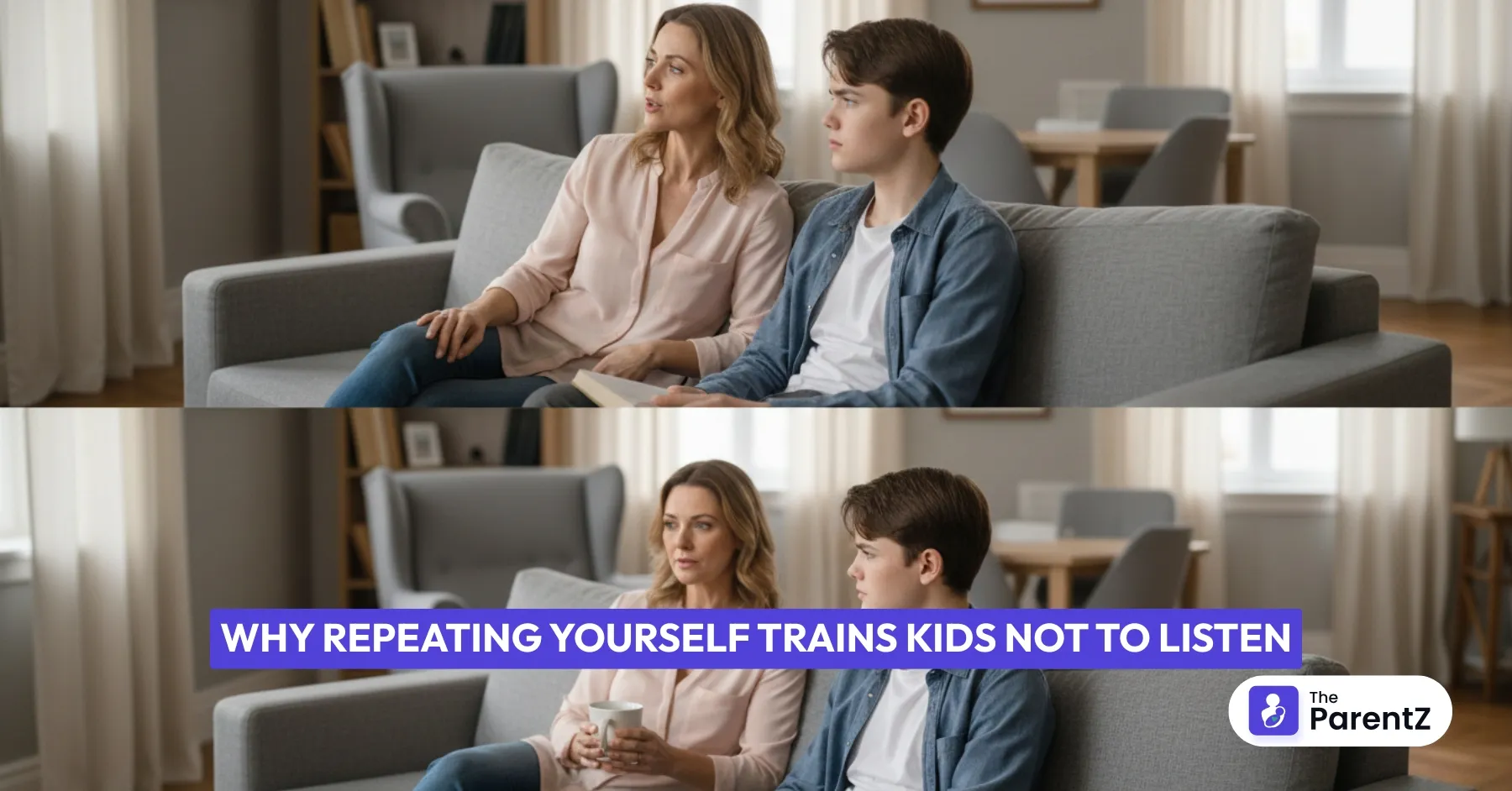
You've said it three times. Four times. "Put your shoes on." "We need to leave." "I'm not going to ask again."
Except you will ask again. And your kid knows it.
Every time you repeat yourself, you're teaching your child exactly how many times you'll say something before you actually mean it. You're training them to tune you out until you hit that magic number, usually when your voice gets louder or frustrated.
It starts innocently. Your toddler doesn't respond the first time, so you say it again. They're little, they're learning.
But somewhere along the way, repeating becomes the pattern. They learn that the first request doesn't really count. Neither does the second. It's the third one, when you use that specific tone, that's the real one.
When you repeat the same instruction multiple times, your child's brain starts filtering it out as background noise. It's not always defiance. It's just how brains work. If something gets repeated without consequence, it becomes less important.
If Mom says "five more minutes" six times before we actually leave, then "five more minutes" doesn't really mean five minutes. It means "keep playing until Mom sounds really serious."
You're teaching them that your words are optional until they're not. And they can't know when you've crossed from optional to serious, so they wait for the cues, like the tone change, the anger.
Your child isn't ignoring you to be difficult. They're doing what you've trained them to do, i.e, wait for the real request.
Meanwhile, you're getting increasingly frustrated. You're repeating yourself, your blood pressure's rising, and you're wondering why your child won't listen the first time.
It's a cycle that makes everyone miserable.
Say it once, mean it, and follow through.
Sounds simple, right? It's not. Because following through is uncomfortable. It means stopping what you're doing. It means your child might get upset.
Before you say something, ask yourself: Am I ready to follow through right now? If not, don't say it yet.
When you're ready, get close to your child. Make eye contact. "Aarav, we're leaving in five minutes. When the timer goes off, we're walking to the car."
Then, when the timer goes off, you leave. Even if they're not ready. Even if they protest. You help them with their shoes if needed, but you follow through.
"If you don't clean up, we're not going to the park" only works if you're genuinely willing to cancel the park.
Instead, offer real choices. "You can clean up now, and we have time for the park, or you can keep playing, and we'll skip the park today."
Then respect their choice, even if it's not what you wanted. If they choose to keep playing, there's no park. No bargaining.
This isn't about being harsh. It's about meaning what you say, so your words carry weight.
Sometimes kids genuinely don't hear us. They're focused on their game or their thoughts. That's not selective hearing, that's normal childhood brain function.
Before you assume they're ignoring you, get on their level. Touch their shoulder. Wait for eye contact. "I need you to listen to something important."
Then say what you need to say. Ask them to repeat it back. "What did I just ask you to do?" If they can't repeat it, they didn't really hear it.
You don't always need to enforce consequences. Sometimes life does it for you.
If they don't put their lunch box in the bag, they don't have lunch at school. If they don't put clothes in the hamper, those clothes don't get washed. If they refuse to wear a jacket, they might be cold.
Your job isn't to rescue them from every uncomfortable situation. Natural consequences are powerful teachers. (This doesn't apply to safety issues.)
There are times when repetition is fine. If you're teaching something new, they need reminders. If they're genuinely distracted, a second attempt is fair.
But the daily routines they know by heart? Things you've asked a hundred times? That's where the one-ask rule matters most.
You can say something once and mean it without yelling. When you follow through calmly, your child learns that your regular voice is the one they need to listen to, not just your angry one.
If you feel yourself getting frustrated, take a breath. Give them a moment to process. Then follow through without anger.
This isn't about becoming strict or inflexible. It's about making your words matter so that when you do need your child to listen, like in emergencies or important moments, they actually do.
Start small. Pick one thing you repeat constantly and commit to saying it once. Follow through every time.
Your relationship with your child will improve when they know what to expect from you. Less frustration on both sides. Less yelling. More cooperation.
You're teaching them that words have meaning, that you respect yourself enough to mean what you say, and that they're capable of listening the first time.
TheParentZ offers expert parenting tips & advice, along with tools for for tracking baby and child growth and development. Know more about Baby Growth and Development Tracker App.It serves as an online community for parents, providing valuable information on baby names, health, nutrition, activities, product reviews, childcare, child development and more
Disclaimer:
The views, thoughts, and opinions expressed in this article/blog are solely those of the author and do not necessarily reflect the views of The ParentZ. Any omissions, errors, or inaccuracies are the responsibility of the author. The ParentZ assumes no liability or responsibility for any content presented. Always consult a qualified professional for specific advice related to parenting, health, or child development.
Conversations (Comments) are opinions of our readers and are subject to our Community Guidelines.



Be the first one to comment on this story.