
Most Moms Report Slower Recovery After a Second Birth
Jul 19, 2026By Dr. Akanksha Priya
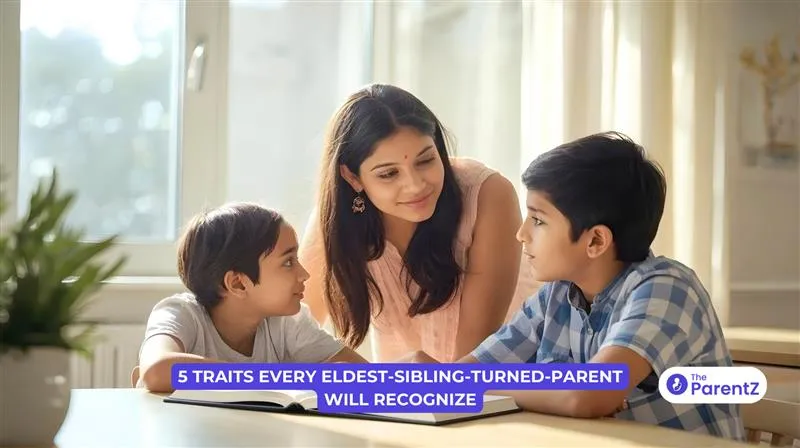
You know that moment when you catch yourself saying "because I said so" to your child, and suddenly you realize you sound exactly like yourself at age 10, bossing your younger siblings around? Or when you hover over your kid's homework, double-checking every answer, making sure it's perfect?
If you were the oldest sibling growing up, chances are your childhood role is quietly directing how you parent today. So, let’s explore the ways your oldest-sibling experience is influencing your parenting right now.
Remember how your parents had a million rules for you, but by the time your youngest sibling came along, those same parents were pretty chill? Well, research shows that first-time parents tend to be more anxious and rule-focused with their firstborns, and this pattern often continues when those firstborns become parents themselves.
If you're an oldest sibling parent, you might find yourself setting bedtimes down to the exact minute, checking your child's school bag every morning, or having very specific rules about screen time. Your younger sibling parents? They might be more flexible, more "let's see how it goes."
This isn't bad, as structure and consistency are actually great for kids. But sometimes, this strictness can tip into being too rigid. You might catch yourself saying "no" before you've even thought about whether something is actually harmful or just different from how you did things.
Pro Tip: Next time you're about to enforce a rule, pause and ask yourself, Is this about safety and values, or is it about control? There's a difference.
If you've ever redone your child's art project because it "wasn't quite right," or felt genuine anxiety when your kid got a B+ instead of an A, welcome to the oldest-sibling-parent club.
According to psychologists, the oldest children often develop perfectionist tendencies because their parents put high expectations on them. You were supposed to be the role model, the example, the one who gets everything right. And now? You're accidentally putting that same pressure on your own kids.
You might notice yourself:
This happens because your younger siblings probably got to mess up more freely. They had you to watch and learn from. They had parents who had already made mistakes and relaxed a bit. But you? You were learning everything for the first time with parents who were also figuring it out.
Pro Tip: Once you recognize this pattern, you can choose differently. Your child doesn't need to be perfect. They need to be loved, supported, and given room to make mistakes.
Ever notice how you can't just let your child figure something out on their own? You jump in to explain, to guide, to teach. That's your oldest-sibling training kicking in.
As the oldest, you spent years explaining things to younger siblings, helping them tie their shoes, teaching them how to play games, and showing them the "right way" to do things. It became second nature. And now, you're doing the same with your children, but maybe a bit too much.
Research shows that the oldest children often take on teaching roles naturally because they had younger siblings looking up to them. This can be wonderful. You're probably great at breaking down complex ideas for your kids. But sometimes, they need to struggle a bit, to figure things out themselves, to learn from their own mistakes rather than your guidance.
Pro Tip: When your child is working on something, count to 10 before offering help. Let them ask for it first. You'll be surprised how often they figure it out on their own.
How often do you feel like everything falls on your shoulders? The planning, the remembering, the organizing? And how quickly do you give your children responsibilities, maybe even age-inappropriate ones?
Oldest siblings often carry a deep sense of responsibility that was developed when they had to watch younger siblings, set examples, and be dependable.
This manifests in parenting as:
The flip side? Your kids learn great responsibility skills from you. They see someone who follows through, who keeps commitments, who can be counted on. That's valuable. The key is balance and letting kids be kids.
As the oldest sibling, you probably developed good skills for managing multiple things at once. You learned to handle noise, interruptions, and younger siblings who needed attention while you were trying to do homework. This makes you pretty good at managing the chaos of family life.
But you're also probably always trying to minimize that chaos. You want order. You make schedules. You plan ahead. You feel uncomfortable when things are messy or unpredictable.
Watch yourself during a typical morning. Are you rushing everyone, keeping tight schedules, getting stressed when things don't go according to plan? That's your oldest-sibling need for control showing up.
Don’t get us wrong. Your organizational skills are an asset. Your children benefit from having a parent who can juggle multiple needs. But they also need a parent who can sometimes let the schedule slide, who can be spontaneous, who can tolerate a messy playroom without immediately needing to clean it.
None of this is about being a "bad parent." Being shaped by your oldest-sibling experience isn't wrong; it's just your story. Understanding it helps you make conscious choices instead of automatic reactions.
You bring so many strengths to parenting because you were the oldest. You're responsible, organized, and capable of teaching and guiding. You can handle a lot. Your kids are lucky to have a parent who cares so deeply about doing things right.
The goal isn't to erase your oldest-sibling traits. It's to be aware of them, to recognize when they're helpful and when they might be holding you back.
The next time you find yourself being extra strict, or hovering over homework, or feeling like everything depends on you, take a breath. Think about where that's coming from. And then ask yourself: What does my child actually need from me right now?
Sometimes it's structure and guidance. Sometimes it's freedom to fail. Sometimes it's just a parent who can sit on the floor and be silly without worrying about whether everything is perfect.
It's okay to parent differently than how you were parented, or different from how your role as the oldest sibling taught you. Your awareness is already the first step toward being the parent you want to be.
TheParentZ offers expert parenting tips & advice, along with tools for for tracking baby and child growth and development. Know more about Baby Growth and Development Tracker App.It serves as an online community for parents, providing valuable information on baby names, health, nutrition, activities, product reviews, childcare, child development and more
Disclaimer:
The views, thoughts, and opinions expressed in this article/blog are solely those of the author and do not necessarily reflect the views of The ParentZ. Any omissions, errors, or inaccuracies are the responsibility of the author. The ParentZ assumes no liability or responsibility for any content presented. Always consult a qualified professional for specific advice related to parenting, health, or child development.
Conversations (Comments) are opinions of our readers and are subject to our Community Guidelines.


Be the first one to comment on this story.