Most Moms Report Slower Recovery After a Second Birth
Jul 19, 2026By Dr. Akanksha Priya
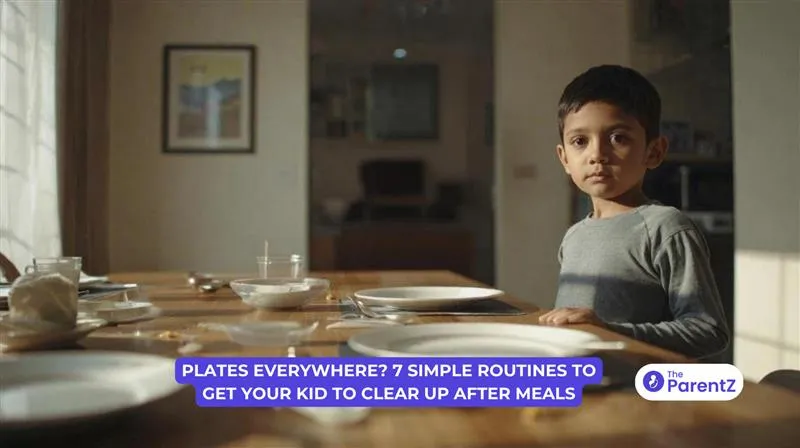
You finish lunch. Your child pushes back their chair, half-eaten food still on the plate, and walks away. The plate sits there. Waiting. For you. Or the house help. Or just someone who isn't them.
This scene plays out everywhere, from Mumbai apartments to Delhi houses. The plates pile up. The cups get left behind. And someone else always picks up the pieces.
But what most of us don't realize is that this isn't just about dirty dishes. It's about what our kids are learning, or not learning, about responsibility.
When kids are tiny, we do everything for them. But somewhere along the way, we forget to shift gears. Maybe the house help always clears the table. Maybe we're so used to doing it that we don't think to ask. Maybe we grew up where mothers handled everything.
In many households, there's this belief that childhood should be about studies, not chores. "Let them focus on books," relatives say. But research tells a different story.
Research found that kids who did household tasks ended up with better work habits, higher self-esteem, and greater life satisfaction as adults.
Children doing chores develop significantly better problem-solving abilities, stronger working memory, and better impulse control. Chores build "executive functioning," which is the brain's ability to plan, focus, and manage time.
When kids don't clear their plates, they miss understanding that homes require effort. They don't develop the automatic cleanup habit, which is much harder to build in adulthood. They don't learn to notice what needs doing without being told.
Most importantly, they don't develop empathy for invisible household work. When kids never participate, they can't see the effort involved.
Whatever you used to eat, you carry to the sink yourself. No exceptions. Even a three-year-old can do this with supervision. Don't worry about rinsing yet—just establish: you ate it, you carry it.
Before taking their last bite, they must look at their plate and commit to what comes next. This two-second pause builds awareness and interrupts the automatic "eat and flee" pattern.
No one leaves the table until everyone's plates are cleared. Older kids help younger ones. This makes cleanup a family moment rather than one person's burden. Yes, there will be grumbling. But within two weeks, it becomes automatic.
Set a timer for five minutes after meals. That's the window for all dishes to reach the kitchen. Beat the timer, everyone wins. Kids understand games and time limits better than lectures about responsibility.
Give each family member a specific spot in the sink area where their dishes go. When kids have ownership of a space, they're more likely to maintain it. Plus, you instantly see who hasn't cleared their plate.
Before scraping their plate, kids say one thing they appreciated about the meal. This connects the food with the person who prepared it. It takes five seconds but builds empathy.
Pick one weekend meal where kids do everything—set the table, serve themselves, clear, rinse, and wipe down. Full cycle. Once a week. This is where they understand what really goes into a meal.
Research shows that household tasks help kids develop empathy by understanding the work that keeps homes running. They start seeing it as everyone's responsibility, not just mom's or the help's job.
The plate they clear today teaches them to notice what needs doing tomorrow. This isn't about perfect children; it's about raising kids who understand that being part of a family means contributing to it.
It makes your life easier too. Imagine not collecting plates from different rooms. Imagine kids who automatically clean up.
That future starts with one plate. One meal. One routine that says that in this family, we take care of each other by taking care of our shared spaces.
Your kids might resist now. But years from now, they'll thank you for teaching them that taking care of their space is everyone's job. Including theirs.
TheParentZ offers expert parenting tips & advice, along with tools for for tracking baby and child growth and development. Know more about Baby Growth and Development Tracker App.It serves as an online community for parents, providing valuable information on baby names, health, nutrition, activities, product reviews, childcare, child development and more
Disclaimer:
The views, thoughts, and opinions expressed in this article/blog are solely those of the author and do not necessarily reflect the views of The ParentZ. Any omissions, errors, or inaccuracies are the responsibility of the author. The ParentZ assumes no liability or responsibility for any content presented. Always consult a qualified professional for specific advice related to parenting, health, or child development.
Conversations (Comments) are opinions of our readers and are subject to our Community Guidelines.


Be the first one to comment on this story.